Fr. Eduardo Emilio Aguero, SCJ
Historical Context
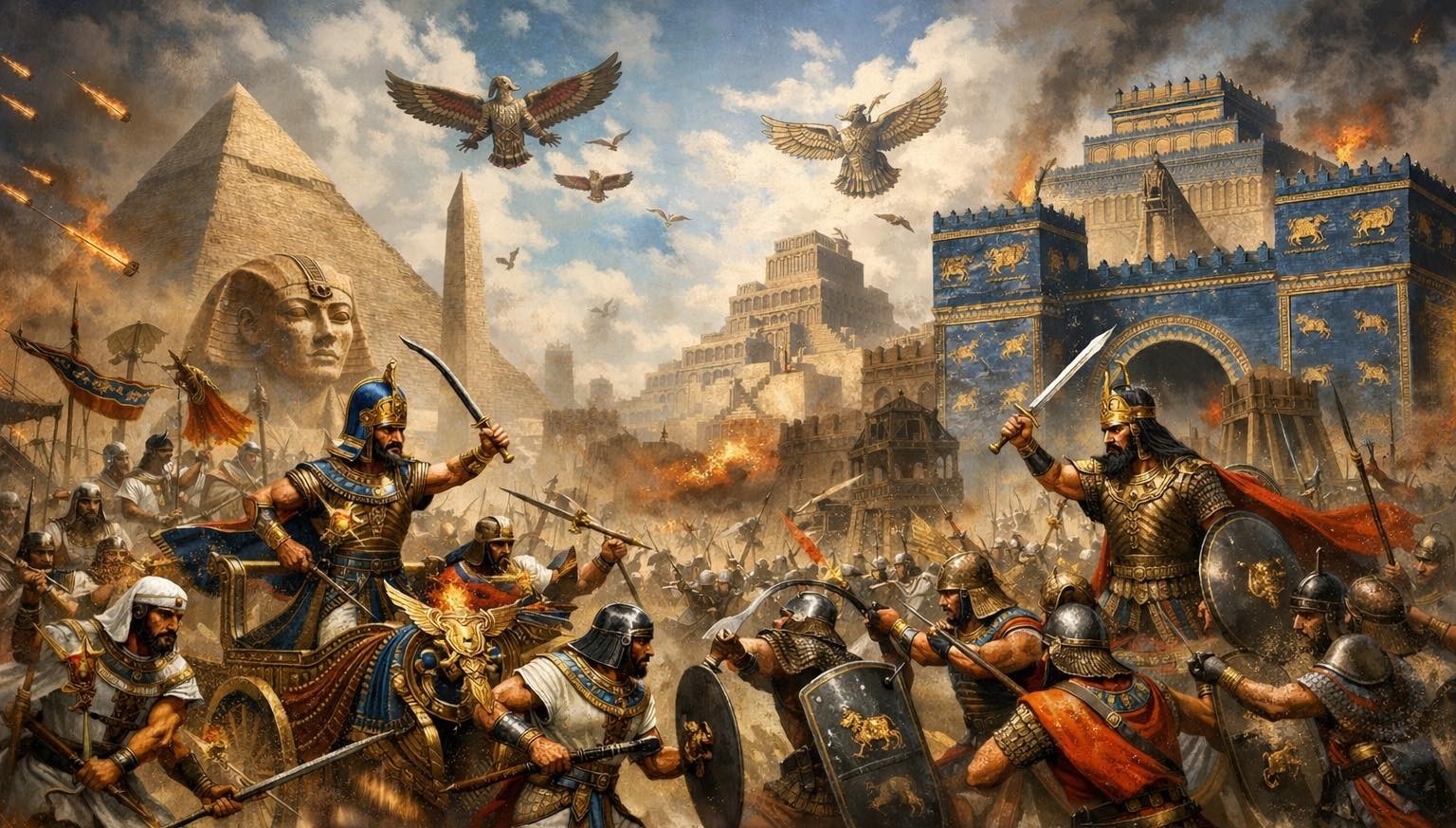
The reference to the Chaldeans in Habakkuk 1:6 situates the prophet within a precise historical moment. The “Chaldeans” are the Babylonians, who rose to power after the decline of Assyria and became the dominant force in the Fertile Crescent. The Neo-Babylonian Empire’s ascendancy was marked by its decisive victory over Pharaoh Necho II at the Battle of Carchemish in 605 B.C. Just four years earlier, in 609 B.C., Necho had defeated and killed King Josiah of Judah at Megiddo. Judah thus found itself caught between two superpowers—Babylon and Egypt—struggling to navigate the strategic pressures of its fragile geopolitical position.Habakkuk’s prophecy is not merely a chronicle of these shifts; it is a profound meditation on divine justice and human faith. Judah’s entanglement between Egypt and Babylon illustrates the vulnerability of nations, while Habakkuk’s dialogue with God reveals the enduring struggle of believers to reconcile divine holiness with historical realities.
A Dialogue with God: Covenant and God’s Justice
Unlike other prophets, Habakkuk addresses no king or people—his sole interlocutor is God. His opening cry is a lament: “O Lord, how long shall I cry for help, and you will not hear? Or cry to you ‘Violence!’ and you will not save?” (Hab 1:2). This prayer initiates a dialogue in which God responds, announcing the rise of the Chaldeans as His instrument of judgment (Hab 1:6).
The sequence of this dialogue unfolds as follows:
- Habakkuk’s lament and complaint (1:2–4): “How long shall I cry for help…Why do you make me see wrongdoing?”
- The Lord’s response (1:5–11): “I am rousing the Chaldeans, that fierce and impetuous nation, who march through the breadth of the earth…”
- Habakkuk’s response (1:12–2:1): “Why do you look on the treacherous and are silent when the wicked swallow the righteous?”
- God’s response (2:2–20): “The just will live by his faithfulness.”
- Habakkuk’s final response (3:1–19): “I have heard…I will rejoice!”
This exchange exposes the tension between God’s holiness and His actions in history. Habakkuk struggles with the paradox: “Your eyes are too pure to look on evil, and you cannot tolerate wrongdoing. Why then do you tolerate the treacherous?” (Hab 1:13). The prophet’s theology of covenant is tested—how can the God of Israel employ a ruthless nation to discipline His people? Yet the dialogue does not end in despair. God affirms that “the righteous shall live by his faithfulness” (Hab 2:4), a covenantal principle that transcends immediate circumstances. Habakkuk ultimately surrenders to God’s mysterious will, concluding with a hymn of thanksgiving: “Though the fig tree does not blossom, nor fruit be on the vines… yet I will rejoice in the Lord, I will exult in the God of my salvation” (Hab 3:17–18).
Waiting for God’s Justice (Habakkuk 2:1–5)
Like a watchman, the prophet waits attentively and vigilantly for the Lord’s response to his second complaint: “I will stand at my watchpost and station myself on the tower; I will keep watch to see what he will say to me, and what he will answer concerning my complaint” (Hab 2:1).God commands Habakkuk to write His words clearly, a message fundamental for understanding His action in human history and the attitude He expects from His faithful: “Look at the proud! Their spirit is not right in them, but the righteous live by their faith” (Hab 2:4). The arrogant, who place their trust in wealth, military strength, or political power, are insatiable—like death itself, which inevitably overtakes them: “Indeed, wine betrays the arrogant; the proud do not endure. They open their throats wide as Sheol; like death they never have enough” (Hab 2:5). In this context, the Hebrew word ’emunah expresses firmness, moral fidelity, and stability in the midst of violence and injustice. Even when it seems the Lord delays, the righteous are called to “hope against hope” (Rom 4:18).
Faith According to Paul and the Christian Tradition
This verse from Habakkuk is cited by Paul in several places: “The one who is righteous will live by faith” (Rom 1:17); “For the one who is righteous will live by faith” (Gal 3:11); and echoed in Heb 10:38: “My righteous one will live by faith. If he shrinks back, I will not be pleased with him.” Martin Luther relied on these Pauline citations to ground his doctrine of salvation by faith and not by works. Yet faith is not an abstract entity; it must be lived by concrete persons in concrete circumstances. The Hebrew word ’emunah, used in Hab 2:4, means more than assent to a belief system—it signifies faithfulness, moral steadfastness, and stability in the face of challenges. Paul, when quoting Hab 2:4, uses the Greek term pistis, which in his context is contrasted with “works of the law” (Gal 3:11) and points to a person’s total reliance on Jesus Christ for salvation. These “works of the law” do not refer to good deeds that Christians are called to perform (cf. Jas 2:17: “So faith by itself, if it has no works, is dead”), but rather to Jewish cultural practices such as circumcision, observance of festivals, and dietary regulations. In his effort at inculturation, Paul did not want Gentile converts to be forced into a sect bound to Judaism, but to form a new community he called “the new Israel” (cf. Gal 6:16: “Peace and mercy be upon all who follow this rule, and upon the Israel of God”). The Christians of Galatia were influenced by Judaizers who disturbed the communities founded by Paul. In response, Paul reaffirmed that salvation comes through faith in Christ, not through adherence to certain cultural practices.
Salvation for All Peoples
By proclaiming that “the righteous will live by his faithfulness” (Hab 2:4), the prophet Habakkuk also opens the horizon of salvation to all peoples. His message transcends Israel’s borders and anticipates the universality of the Gospel: “For the earth will be filled with the knowledge of the glory of the Lord, as the waters cover the sea” (Hab 2:14).
This passage calls for complete trust in the Lord of history, who will fulfill His promise and accomplish His plan. The faithfulness of the righteous is not passive resignation but an active, confident waiting upon the God who governs history and extends His salvation to all nations. This final prayer opens the covenant horizon beyond Judah, pointing to a universal vision of God’s justice and mercy. Habakkuk’s dialogue becomes not only a testimony of Israel’s struggle but also an invitation to all peoples to trust in the sovereignty of God, even when His ways defy human expectation.
Praying with the Word of God
- Meditate on Habakkuk’s lament: Bring before God your own cries of “How long, Lord?” and trust that He listens.
- Embrace faithfulness in trials: Ask for the grace to live by ’emunah—steadfast fidelity—even when circumstances seem overwhelming.
- Rejoice in God’s salvation: Pray with Habakkuk’s hymn, “Yet I will rejoice in the Lord, I will exult in the God of my salvation” (Hab 3:18), making it your own act of surrender and praise.
 Follow