Joaquim Magalhães de Castro
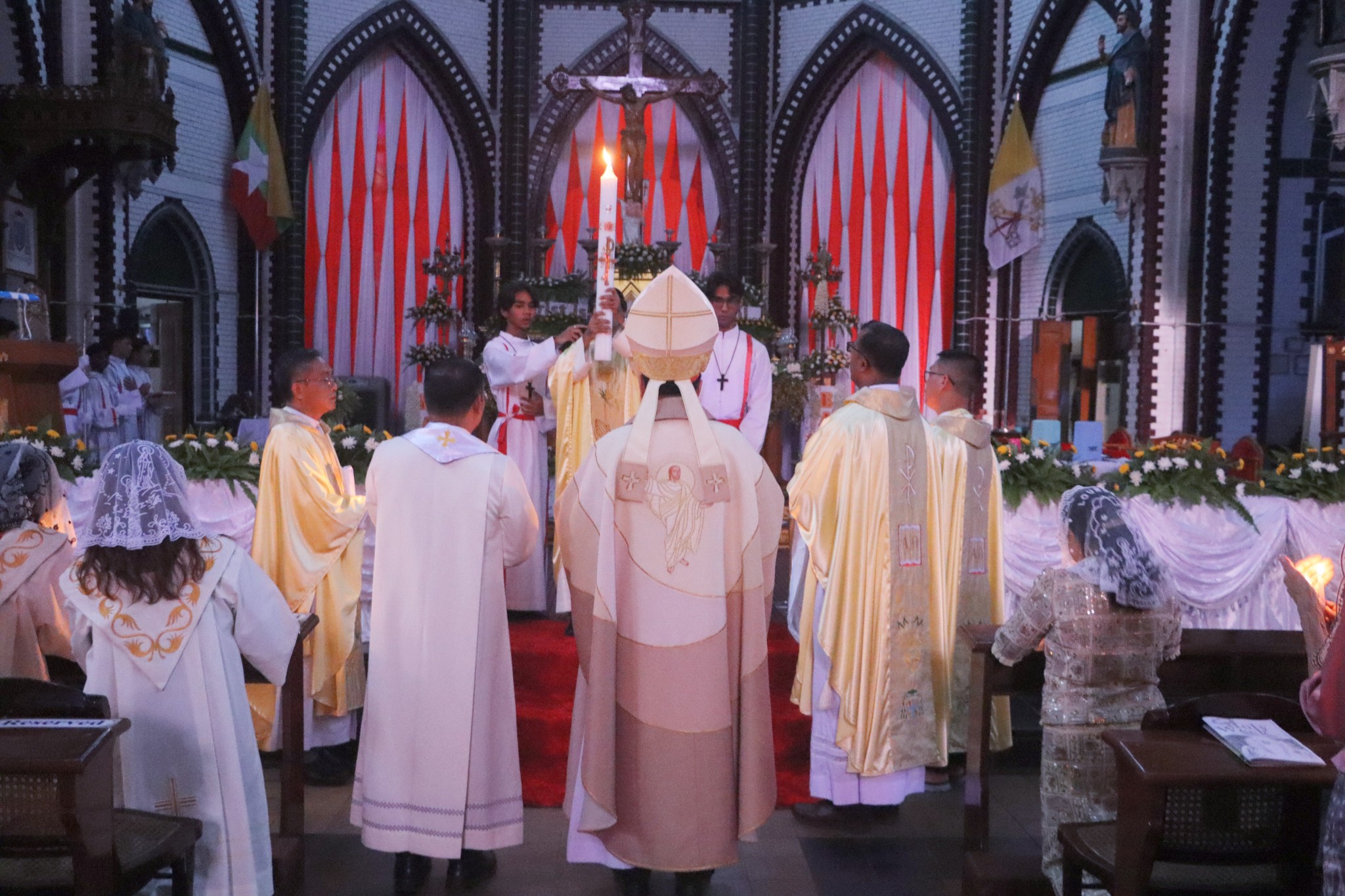
The theme of peace was at the center of the assembly of the Myanmar Episcopal Conference, which recently took place in Yangon and ended with a solemn Mass in the city’s cathedral, presided over by Cardinal Charles Maung Bo, with the closing rite of the Holy Door and the Jubilee Year. All the bishops, priests and religious of Yangon, representatives of other dioceses, numerous nuns, 140 seminarians and thousands of faithful participated in the Mass. Pope Leo XIV’s message for the 59th World Day of Peace, “Peace be with you: towards an ‘unarmed and disarming’ peace,” served as a backdrop for all the contributions presented during the four days of dialogue and assembly of the Burmese bishops.
The bishops gathered in Yangon, despite the difficulties of travel due to the precarious situation and the numerous checkpoints along the road, filled with military posts and armed groups vying for control of the territory. They met to share their concerns and hopes for the new year. Pope Leo XVI’s words on peace, and specifically on Myanmar, during his “Urbi et Orbi” blessing on December 25, were particularly encouraging and motivating: “Let us ask the Prince of Peace to illuminate Myanmar with the light of a future of reconciliation, restoring hope in younger generations, guiding all its people along the paths of peace and accompanying those who live without shelter, security or confidence in tomorrow.”
In light of the complex situation in Myanmar and global events, the bishops emphasized the urgent need to understand and put into practice the Pope’s words: “It is desirable that all communities throughout the world become a ‘house of peace,’ where people learn to dissipate hostilities through dialogue, to practice justice, and to preserve forgiveness. More than ever, we must show that peace is not a utopia.” In Myanmar, the Burmese bishops emphasized, the Catholic Church is a driving force for peace and reconciliation through men and women who strive daily to live according to the example of Christ, the only source of true peace in a context marked by profound crisis. The bishops also discussed the situation in the areas affected by the recent earthquake, noting that this event was not only a natural disaster but also a test of the resilience and mission of the Catholic Church, which has offered assistance to all people regardless of their religious beliefs or ethnicity. The bishops also addressed Leo XIV’s Apostolic Letter,
“Drawing New Maps of Hope,” which commemorates the 60th anniversary of Vatican II’s declaration ‘Gravissimum educationis,’ and the link between education and evangelization.
The bishops noted that Myanmar’s future depends on educational work for new generations, in which all members of society participate, especially families and schools. They emphasized the importance of well-prepared educators and trainers. In the context of the civil war in Myanmar, the education sector, blocked in many areas, is suffering greatly. Groups of Catholic religious and volunteers are providing educational support to children and young people in numerous communities whose education has been interrupted.
The mission of Catholic communities in the country continues while the nation is in the process of national elections, in the wake of the coup d’état five years ago. The elections, which began on December 28 and are scheduled to take place in several phases until January 25, are being held in areas controlled by the military junta and without the participation of democratic parties. According to a recent analysis published by the BBC, the military controls approximately 21% of Myanmar, including the main cities; 42% is controlled by resistance forces and ethnic militias, while the remainder of the territory is contested by hostilities.
Meanwhile, the military junta that governs the country has released more than 3,000 political prisoners from Insein prison in Yangon. The detainees had been accused of being opponents of the regime after the 2021 coup and charged with “sedition.” The generals stated that the sentences were lifted “to ensure that they do not lose their right to vote in these multi-party democratic general elections.”
The Myanmar National Human Rights Commission, an independent body but composed of commissioners appointed by the government, sent letters to several ministers of the junta with explicit demands: a letter to the Minister of the Interior requested the release of political prisoners, which has already been carried out; In a letter to the Minister of Health, a demand was made to guarantee the right to vote for all patients and hospitalized individuals by establishing special polling stations; and in a letter to the Minister of Social Welfare, a demand was made to allow all people with disabilities to exercise their right and duty to vote.
“We welcome the release of prisoners and hope that others will also be released or receive amnesty. We believe that elections are the fundamental instrument of democracy and, therefore, we support the electoral process, demanding that it be free and transparent,” Joseph Win Hlaing Oo, a Catholic and member of Myanmar’s National Human Rights Commission, told the Fides news agency.
 Follow