Fr. Eduardo Emilio Aguero, SCJ
1. The Surprise of Humility
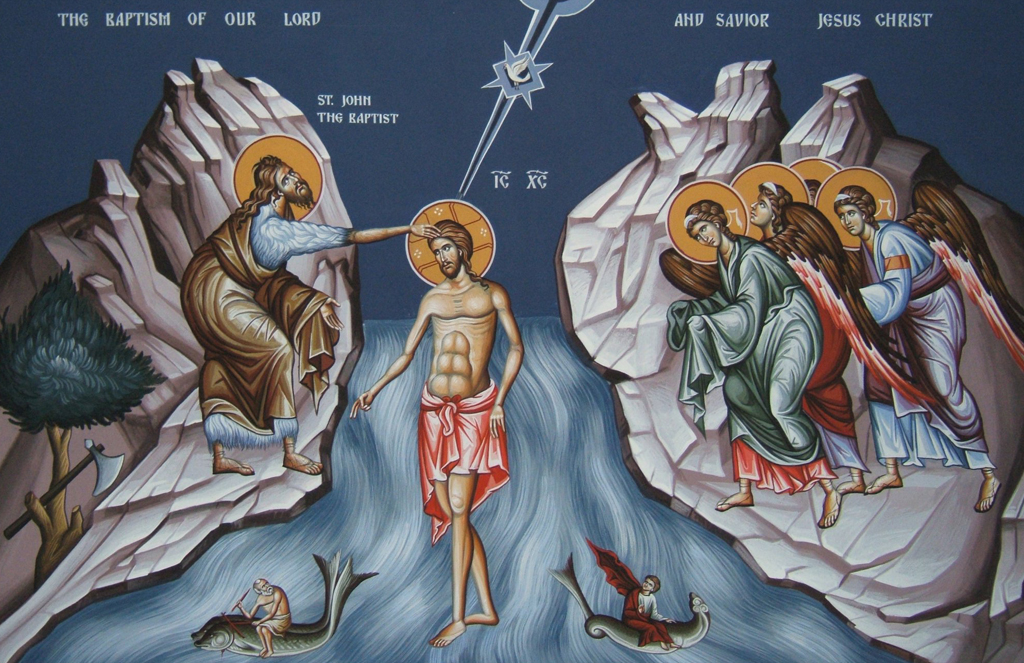
This Sunday we celebrate the Feast of the Baptism of the Lord, closing the Christmas season and opening Ordinary Time in this new year. The baptism of Jesus marks the beginning of his public ministry. I remember the last time I returned to my country, Argentina. Arriving at our community house in Buenos Aires, I encountered a shocking image: Monsignor Virginio Bressanelly, SCJ, a former General Superior of our congregation and a retired bishop of more than 80 years of age, was washing the sidewalk of our house! Although I knew of his simplicity, as he had been my formator, to see an ex-general superior and a bishop doing that kind of work gave me a great surprise. I believe that John the Baptist was even more shocked when he saw his cousin Jesus coming to him, blending into the great mass of sinners, to be baptized by him.
2. John the Baptist: Voice in the Desert
Jesus went all the way from Galilee, leaving his mother and family, to the banks of the Jordan near Bethany, where John was baptizing. John is the “voice crying in the wilderness” (Isaiah 40:3), the one who was to “prepare the way of the Lord.” The prophetic voice had been silent for four centuries after the post-exilic prophet Malachi announced the return of Elijah: “Lo, I will send you the prophet Elijah before the great and terrible day of the Lord comes” (Malachi 4:5). Now, Jesus testified that Elijah had returned in the person of John (cf. Matthew 11:14). Jesus does not speak of reincarnation but of the coming of a prophet as powerful and zealous as Elijah. Indeed, great crowds went to him from all corners of Judea, Samaria, Galilee, and beyond. His impact was immense, fueling messianic hopes in a time of strife, foreign occupation, and despair. Strangely enough, this prophet was not inviting people to take up arms against the oppressors. He was urging them to conversion, to confess their sins, and to change their ways. The way of the Lord he was preparing was to be built in the hearts and souls of each person—a place where no foreign invader or tyrant can ever reach, where no indoctrination can be effective. This was an inner liberation from the oppression of sin, a purification from selfish desires that dehumanize us and establish hostility and violence in our midst. There was the need of a “stronger one” to deliver us from that alienation under the forces of evil: “But if it is by the finger of God that I cast out demons, then the kingdom of God has come upon you. When a strong man, fully armed, guards his castle, his property is safe. But when one stronger than he attacks him and overpowers him, he takes away his armor in which he trusted and divides his plunder” (Luke 11:20–22). John’s way of life and clothing in the desert resembled that of Elijah, signalling a life of penance and inner transformation. A prophet is a man of God, someone who has experienced God’s word in the depths of his being. He was to fulfill the will of God, or as Matthew puts it, “all righteousness” (Matthew 3:15). When Jesus presented himself to John and asked to be baptized, John reacted as any of us would have: “I need to be baptized by you, and do you come to me?” (Matthew 3:14).
3. Jesus: The Servant Who Saves
We could ask: Did Jesus need to convert? What sins should he confess if he was born sinless? His response to John helps us understand: “Let it be so now; it is proper for us to do this to fulfil all righteousness.” Then John consented (Matthew 3:15).
John had come to fulfil God’s will, calling people to conversion. A prophet is sent to accomplish God’s will. When Jesus, the Lamb of God (John 1:29), asks him to fulfil “all righteousness,” John assents and baptizes him. And what is God’s will? By being baptized, Jesus aligns himself with sinners, identifying with sinful humanity. Descending into the Jordan, Jesus anticipates his own death. Carrying the burden of our sin foreshadows the carrying of the cross to Golgotha. As St. Paul writes: “For just as through the disobedience of the one man the many were made sinners, so also through the obedience of the one man the many will be made righteous” (Romans 5:19). This mystery would only be fully comprehended after the resurrection of the Lord. Baptism is the reenacting of the death and resurrection of Christ, taking effect in every Christian on the day of entering into the life of grace. It is our true rebirth into the life of God in the communion of saints. Jesus’ descent into the Jordan is also a figure of his descent into Hades to liberate those bound by the devil in “the land of deep darkness” (Isaiah 9:2). Jesus presents himself as a servant. Though he himself had not sinned, he takes up the yoke of our sins, identifying himself with sinful humanity. This is “all righteousness”: God wants to save us from our own reality. What is not assumed is not redeemed. “Surely he took up our pain and bore our suffering, yet we considered him punished by God, stricken by him, and afflicted. But he was pierced for our transgressions, he was crushed for our iniquities; the punishment that brought us peace was on him, and by his wounds we are healed” (Isaiah 53:4–5). Thank you, Jesus, for saving us in that mysterious way and showing us the path to humility and service. Help us not to be scandalized by sin nor draw away from your lost sheep, but give us a compassionate heart like yours, who deigned to abase yourself to our pitiful condition and raise us to true life.
 Follow